

Handheld laser welding up to 8.5 mm
How laser cleaning worksStuff you
should know
Laser cleaning removes rust, paint, oxides, grease, and other contaminants with short, high-energy pulses of light.
The base material stays untouched
What is laser cleaning?
Laser cleaning removes rust, paint, oxides, grease, and other contaminants with short, high-energy pulses of light.
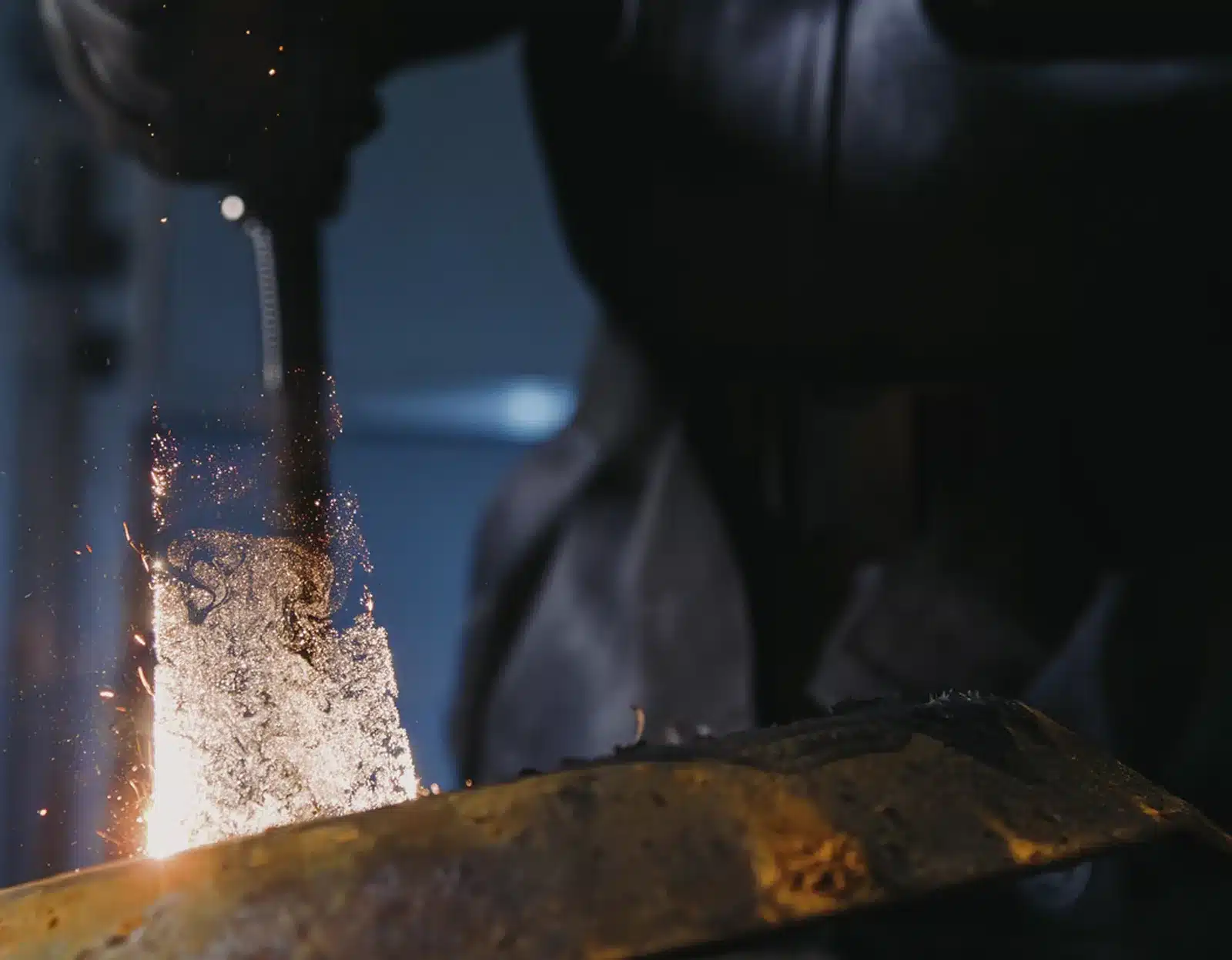
The laser beam hits the surface and is absorbed by the unwanted layer. That layer heats up instantly. A microscopic pressure zone forms between the contamination and the base material, lifting the unwanted material away.
Depending on the job, the contamination either vaporizes or breaks into fine particles that can be extracted safely.
The important part: when the process is set up correctly, the base material stays untouched.
That is what makes laser cleaning so useful. It gives you precise surface preparation without grinding, blasting, chemicals, or unnecessary damage. It works on stainless steel, aluminum, structural steel, copper, stone, and even select woods and plastics.
The process window
Why the base metal survives
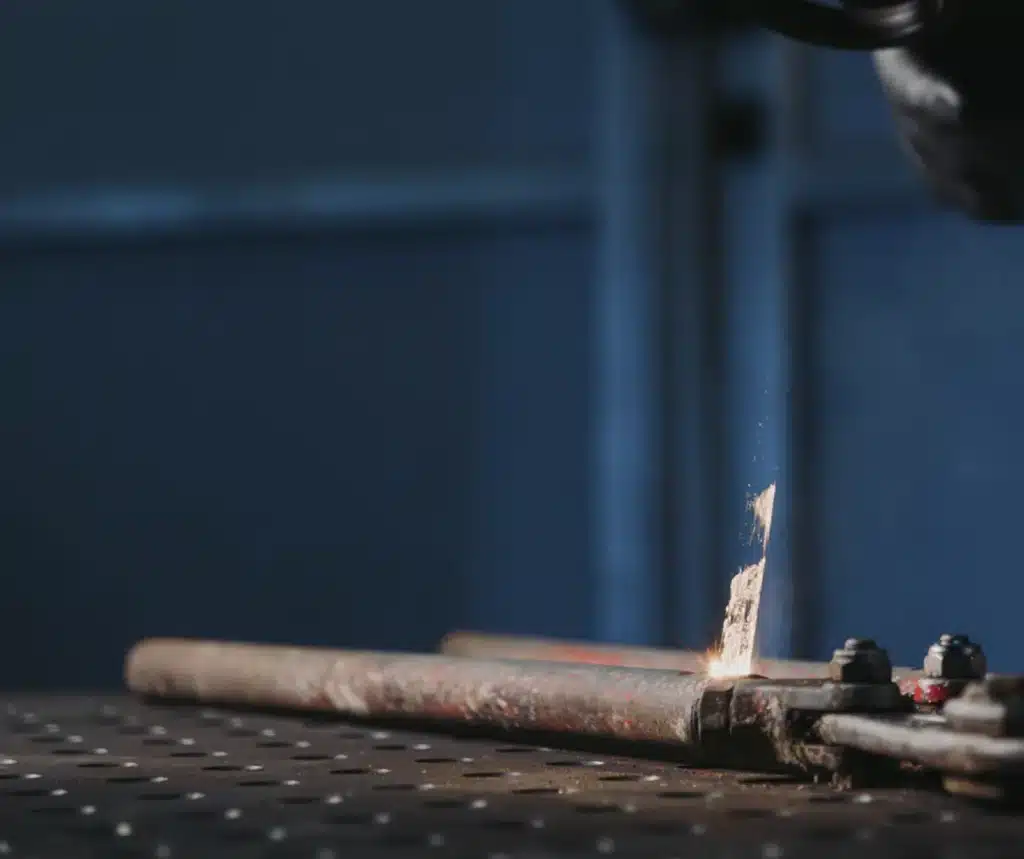
Contamination and metal absorb the same light differently. Rust, paint and oxide layers take up much of the beam’s energy and heat up fast. Clean metal reflects more of it.
That gap gives every job a process window. Below a minimum energy per area, nothing comes off. Above a maximum, the beam starts to affect the metal underneath. Good cleaning sits between the two.
So “untouched” depends on the set-up. Too much energy or too many passes on one spot can still change the surface. Test on a sample of your part first.
Parameters
The settings an operator controls
- Pulse energy and pulse width. Energy per pulse, spread over the spot, sets how hard each pulse hits. Shorter pulses leave less time for heat to spread.
- Pulse frequency. At the same average power, a higher frequency means less energy in each pulse. It changes both how hard and how often the surface is hit.
- Spot size. Energy per area is pulse energy divided by spot area. A smaller spot raises it sharply.
- Scan speed and fill spacing. These set how far apart the spots land and how much they overlap. More overlap puts more energy into the same area.
On the TM-300 you set these on the touchscreen or from the handle. Pulse width runs from 10 to 500 ns, scan speed goes up to 7,500 mm/s, and you choose among four scan patterns and three lenses. Presets cover common jobs.
Less heat. More control.
Why the TM-300 uses pulsed MOPA
Some laser cleaners use continuous-wave technology. Constant heat input on the surface tends to melt the base material during cleaning, even when the contamination is fully removed.
The TM-300 uses MOPA pulsed laser technology instead. MOPA delivers short, controlled bursts of energy, the critical factor in cleaning without damage.
Fumes
Where the removed material goes
The beam does not make dirt disappear. Part of the layer vaporizes, the rest leaves as fine particles. Together they form a plume above the work area that you should not breathe.
What is in it depends on what you remove. Old coatings can contain lead, chromates or zinc, or plastics that break down into harmful products. If you do not know the coating, have it analyzed before you start.
A fume extractor close to the cleaning head catches the plume where it forms. Where extraction alone cannot keep exposure low enough, add respiratory protection.
The honest part
What laser cleaning is not good at
It is a precise tool, not a universal one.
- Thick coatings. The beam removes a layer pass by pass. Thick paint systems take more passes, and more time.
- Hidden surfaces. The beam travels in a straight line. Inside corners, bores and the back of a pipe are hard to reach.
- Mirror finishes. Laser cleaning can raise surface roughness. If you need a polished finish, plan a follow-up step.
Before the first pass
Safety basics
The TM-300 is a Class 4 laser product under EN 60825-1. It emits invisible near-infrared light at about 1064 nm. The beam and its reflections off the workpiece can injure eyes and skin and can start a fire.
- Eyes. Wear EN 207:2017 certified laser safety goggles that cover the machine’s whole wavelength range. The operator manual specifies OD7+ for 1060 to 1070 nm. Three pairs come with the machine. Everyone near the machine wears the same protection.
- Area. Work inside a defined laser area with warning signs at every entrance, keep combustible material out of it, and let nobody enter without protection.
- Air. Extract the plume and wear respiratory protection.
- People. Name one person who is responsible for laser safety.
Training
Laser Safety Officer training
Laser Safety Officer (LSO) training is for those responsible for laser safety, including safety engineers, occupational safety specialists, and technical personnel. Courses cover safety basics, hazard analysis, risk assessment, and protective measures, certifying operators to manage Class 3B and 4 systems in compliance with regulations.
THEO Academy
Sharpen your skills.
THEO Academy gives you expert guidance to sharpen your skills and keep you laser-safe, whether you are just starting out or already a pro. Sign up for free access to our digital courses.

See the TM-300 at work
Request an online demo with the THEO Applications lab, see it at a THEO Partner near you, or ask for a quote.
